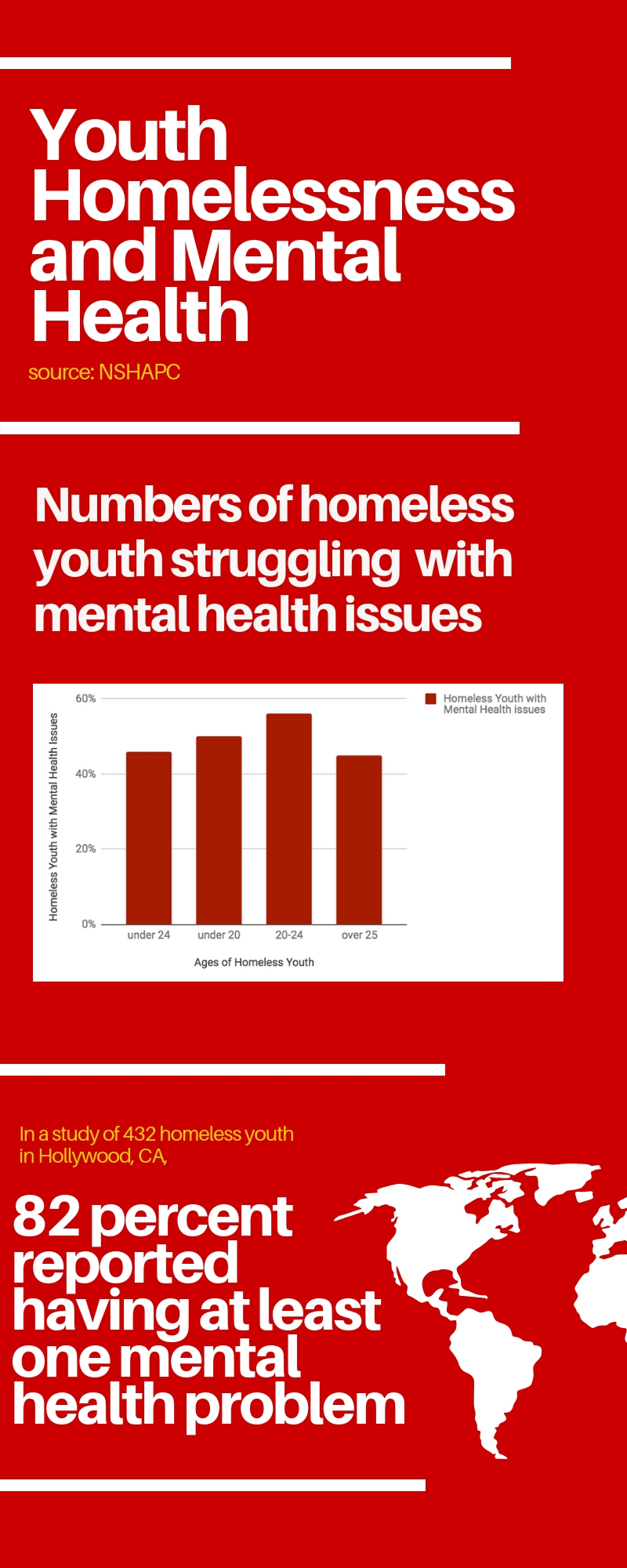
This issue is especially upsetting because of how prevalent it is within the homeless population, and how many of these people’s situations could have been avoided if they got the proper help they needed. I think it is easy to forget about mental health issues as a real problem because we have so many resources and support systems available to us when we are struggling so we can forget that not everyone has these resources. Growing up and being young is difficult enough, but having to deal with living on the streets and struggling to survive can be detrimental to anyone’s mental well-being. I know firsthand how mental health issues like depression and anxiety and negatively impact one’s life, but I am lucky that I have the resources available to help lessen the blow. The young people living on the streets don’t have enough money for food let alone the proper resources to get better, therefore it’s difficult to give these people the hope that they need to move forward. I think the first step is making sure homeless shelters and assistance organizations have the proper resources to help homeless people with mental health issues, so they not only get the basic support that they need, but the emotional support as well.
One thing that I thought was interesting about the homelessness epidemic in the LGBTQ community was how difficult it is to gather statistics about the issue since many LGBTQ youth feel afraid to come out and talk about their situations publicly. It was also interesting to learn about how the resources that are available for homeless LGBTQ youth today were not available to youth even just 10 years ago. The example of Ali Forney really struck me, and how if he had a center like the Ali Forney Center in his time, his life could have been saved. I think it’s easy to not think about the struggles that LGBTQ youth face on a daily basis, and how hard it must be to fear losing your own family just because you want to be yourself. My group and I even decided to switch our social issue to LGBTQ discrimination because there are so many problems that need to be addressed that are related to this issue, and it affects so many people in our society. I also thought that it was really great that centers were also helping families to be better accepting of their children since the ultimate goal would be to keep families together instead of just providing services for the children that become homeless. With my group’s project, the main thing we want to focus on is transgender youth, and how to make them feel more accepted in both their families and their societies. We think transgender children are put in a specifically difficult situation, as they often know of their orientation at a very early age. This also makes things difficult for parents, as many parents have a vision of what they want their child to be, and children who are struggling with this might not fit into their parent’s vision. We mainly just want to help create environments where these children feel like they can be who they are without any repercussions or fear because that is what every child deserves.
In this song, Kendrick addresses many issues surrounding his home town of Compton in California. The most prevalent being gang and gun violence in the street of this underprivileged town. He rapped about hearing shots fired constantly and even coming face to face with gang members. However, even though everyone around him was angry and violent, he was not this way. Kendrick explains that he is just trying to stay out of the way and not get caught up in the madness of this city. When he says “I don’t even push a line, I’m just tryna push these rhymes”, he means that he has bigger and better dreams than staying in this mentally and physically toxic neighborhood forever. In addition, he not only wants to physically leave, but he wants his viewpoints to change too. He states: “I’m tryna duck the influence of my city”, but what he really means is that he wants to get out before he can let the negative impacts of the city change the way he views the world. He is still trying to have a positive outlook on life going forward despite the negativity happening around him in Compton
Window Pain- J Cole
In this song, J Cole talks about different issues like poverty, gun violence, and gang affliation. in the intro and outro of the song J Cole is talking to a little girl who witnessed gun violence and she said that everything bad that happens in world is due to God preparing us for his arrival. Also, he talks about his friends who are acting crazy by doing things like gang violence, doing drugs, impregnating girls that they barely know, and spending money like it’s nothing in these lyrics: “Niggas will rep any gang, niggas will bust any head, Niggas will risk everything, point him out and then he dead,Shootin’ up where his granny live, “blaow, blaow!”, his granny duck, He don’t give a fuck, he’s on Henny and Xanny’d up Blowin’ Tammy up, bitch, when you gon’ give them panties up?, He gon’ plant a seed, but best believe he ain’t man enough”
No Role Modelz- J Cole
Often in Hollywood people will do anything for fame and attention. J Cole grew up ironically in the suburbs but later moved in with his brother in a trailer park. His mother became addicted to cocaine and his father was very abusive. This unstable upbringing impacted how he looks at the world. In this song, he talks about how he lacked a father image growing up and really had, as the title states no “role models.” People who grow up poor have a disservice because they do not have means to succeed in life. Jermaine is tired of all the women who are desperate and dumb. Money draws all types of women for rappers but most of the time they only want the material things.
Paranoia- Chance the Rapper
This song touches on a few different social issues, but the main overriding theme is on the issue of gun violence, and the fear that it instills in the people living in these dangerous communities. With this song, Chance is trying to communicate what it is really like to live in a place with such high homicide rates, and bring attention to actual people living in these communities instead of just the high rates of crime and violence. The hook of the song summarizes the issue well, he says
“With the sun in my eyes and my gun on my hip, Paranoia on my mind, got my mind on the fritz”.
He is referring to the fear that people in inner-city neighborhoods have due to the high rates of gun violence, and how they feel it’s necessary to carry a gun to protect themselves, even when walking around in the daytime. This speaks to how dangerous inner city communities like South Side of Chicago actually are, and that the people are constantly in fear of losing their own life or the lives of their loved ones.
This is America- Childish Gambino
“This is America” by Childish Gambino is the first single he put out since his last album “Awaken, my Love!” in 2016. The song, which was released with a video relays a message of guns and violence in America. It also explores the idea that we as citizens and Americans deal with guns and violence and consume them as part of entertainment while also having it be a part of our national conversation. The video takes us through even more than the song, as it depicts where and what is going on in the song. Donald Glover is a human. He is capable of taking the lives of anyone, which he is seen doing in the video and it serves as a reminder that he is similar to the rest of us humans. When violent things occur in the video, they are met by dancing and celebrating, which illuminates how quick things can be forgotten about or consumed by entertainment and other issues and trends going on in the world. In this song and video, he emphasizes the issues and what it means to be black in America.
I really liked our discussions this week about how important young people have been in various different movements throughout history. I think a lot of people write off young people nowadays as incapable of being motivated or making a difference, and that couldn’t be more wrong. Young people, especially students, have the ability to connect and communicate with others in a way that others can’t. We have the energy and the passion that movement needs to really spread and succeed, as well as the resources and knowledge that one needs to actually network and connect with others. Getting young people involved I think is necessary for any movement because we ultimately are the ones that will be leading society into the next generation, therefore the movements and organizations that we are involved in are going to be carried on to the next generation as well. As far as longevity goes, getting young people involved in social activism I think is going to be an essential part for any movement. I really enjoyed all the examples of young people getting involved and inspiring real change, it shows that younger generations are capable of motivation and making a difference.
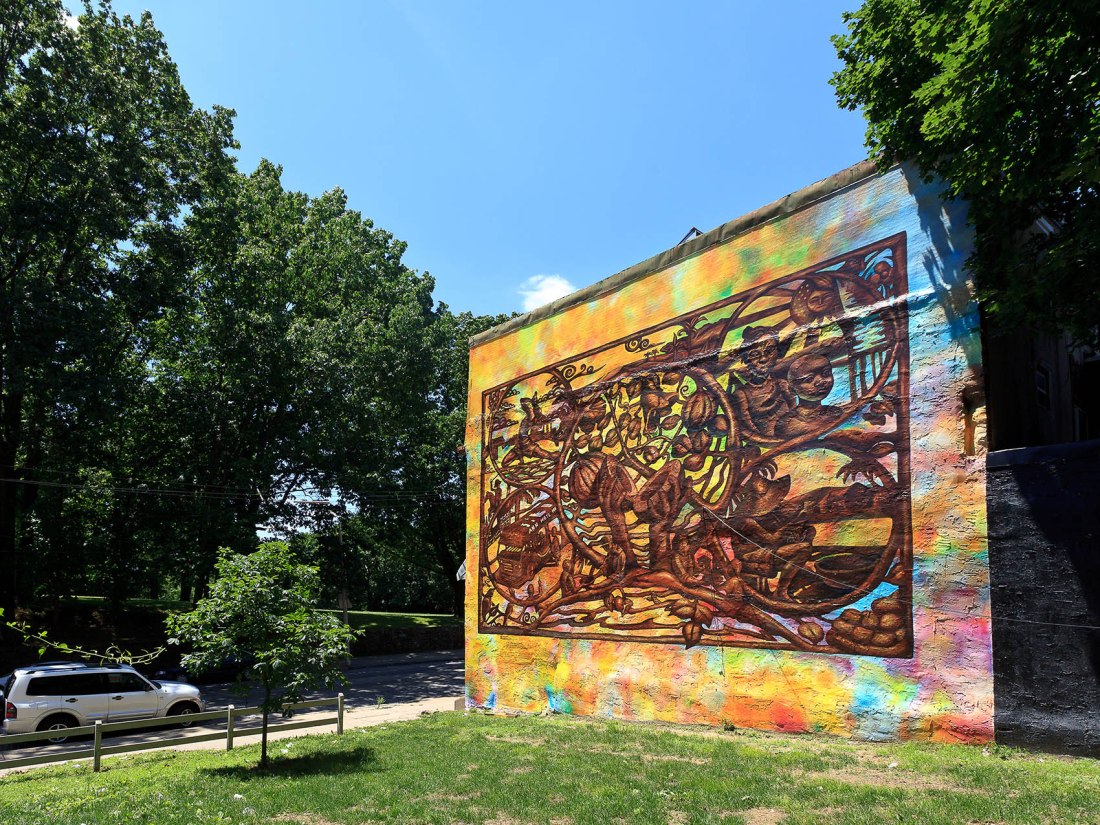
I really liked the topics this week because art is something that can make difficult subjects relatable, and the murals that we looked at this week did a really good job with that. I also think art that is something that is a really effective educational tool because its something that everyone can understand for the most part, as often visual tools can make comprehending certain subjects easier. I am actually excited for the midterm assignment as I think one can’t really get the whole effect of the murals unless you can see them in person. Visual analysis is also something that I have always been interested, and it will be especially interesting for murals as they are guaranteed to have a lot of background and meaning behind them. The mural my group chose for our presentation was especially interesting to me as I drive through Germantown to get to work, and although I don’t drive by the mural itself I do pass a lot of Haitian churches and other aspects to show the presence of the Haitian community in that area. I think that the way that survivors of the earthquake in Haiti were able to relocate and start over their lives the way that they did, and how they were able to build such a strong community in the process. This mural is meant to represent the resilience of the Haitian community and I think that it definitely accomplishes its purpose.
This week we talked about the different ways people can take action for social movements. Some of these techniques include culture jamming, bodily staging, and other forms of guerrilla communication. One of those techniques that stood out to me the most was culture jamming. I knew some examples of culture jamming before this class, however, I didn’t know that there was a technical term for it that related to communications and social activism. I also thought it was interesting how this topic can relate to satire in entertainment as well. Culture jamming refers to when activists use already existing platforms to display messages, usually in reference to criticizing the actual platform being used. The most common example I knew of was the technique of billboard hacking since I had seen versions of this in the past, but I wasn’t really aware of all the other forms like actual hacking with the Anonymous group. I also was able to see connections between culture jamming and satirical comedy. In class, we watched Kendall Jenners Pepsi commercial, and then right after we watched the SNL sketch that was making fun of the actual commercial. Although satirical comedy isn’t directly considered culture jamming, I saw a lot of connections between the two because both take an already existing topic or format and then alter it in some way to make commentary on a social issue.
I think the most interesting subject for me that we talked about this week was KONY 2012 and clicktivism as a form of social activism. The thing that most struck me was how accurate my personal experience with the KONY movement was to the description of clicktivism and attention-driven activism. The readings explained how these types of movements can gain support and grow awareness for a cause, but usually will fail in spurring real activism and action from its followers. This is exactly what happened with my experience of the KONY movement. When the video first came out, everyone around me including myself became really excited about it, and we even went as far as to create posters and Facebook groups. However, as most clicktivist campaigns do, the excitement burnt out after a few days. Although the people in my school had planned to go out on the date the video provided, the excitement surrounding the movement had died down by then and no one that I knew actually went out that night. I remember driving around the day after looking to see if anyone had put up posters, and I don’t think I saw a single poster around my town. Looking back now, it is so interesting to me to be learning about the tactics that Jason Russell used to create his movement, and how those tactics eventually failed him and led to his downfall.
I think one of my biggest takeaways from this week was the importance of resources and connections when it comes to social activism. To get a movement started, you need to connect with people, or you’ll never get the movement past your own friend group. Making connections and knowing the right people is something that is essential in almost any field of work. Even with non-profit organizations, it’s all about who you know. Especially when creating a social movement, it’s important to analyze and assess all the possible people that could help you and the skills that they could bring to the table. In the video, Tamara talks about how she almost overlooked someone who ended up bringing an extremely valuable skill to her team. This emphasizes how important the people you know are when starting out in any field. It also emphasizes how to be successful it’s important not to underestimate people because you never know what resources they could end up providing you.
Hello my name is Abby Wells and I am a junior Communications major with an English minor. I am taking Civic Media partially because it is a requirement for the Communications major, but also because I wanted to learn more about how media and technology plays a part in our society and civic issues. In our first week of class, we talked about the processes behind social activism and movements, and how those processes are impacted by social media and technology. The Zuckerman reading stood out to me as especially interesting because it talked about different movements that are happening in other parts of the world, and how those movements are affected by technology and media. Something that struck me was the amount of control and power that other nation’s governments have over media and expression, and how activists and movements in those nations have to work so much harder to share their message with the world. Something that I also found interesting was how the everyday citizens of these nations want access to the information that is censored by the government, and that even though they aren’t living in a free society they still want to be informed on the social issues within their own government.